
By: Lauren Chipman | CEO
St. Louis was built to last. By the turn of the 20th century, it was one of the largest and most influential cities in the United States, anchored by bustling river commerce, the Eads Bridge and massive rail terminals like Union Station. The city was a powerhouse of industry: brewing, car manufacturing, brickmaking and steel production.
Central to the city's architectural identity is its literal foundation: St. Louis red clay. The city was home to the world's largest brickmaking companies, including the Hydraulic-Press Brick Company, which produced a highly durable, deep-red brick. The result is dense, beautifully detailed neighborhoods built almost entirely of brick and ornate terracotta, seen most vividly in historic Soulard and Lafayette Square, where we stayed. Around the 1904 World's Fair, a wave of optimism brought the grand, classical forms of the Beaux-Arts civic movement to the city's public spaces, and that same ambition still runs through St. Louis today.
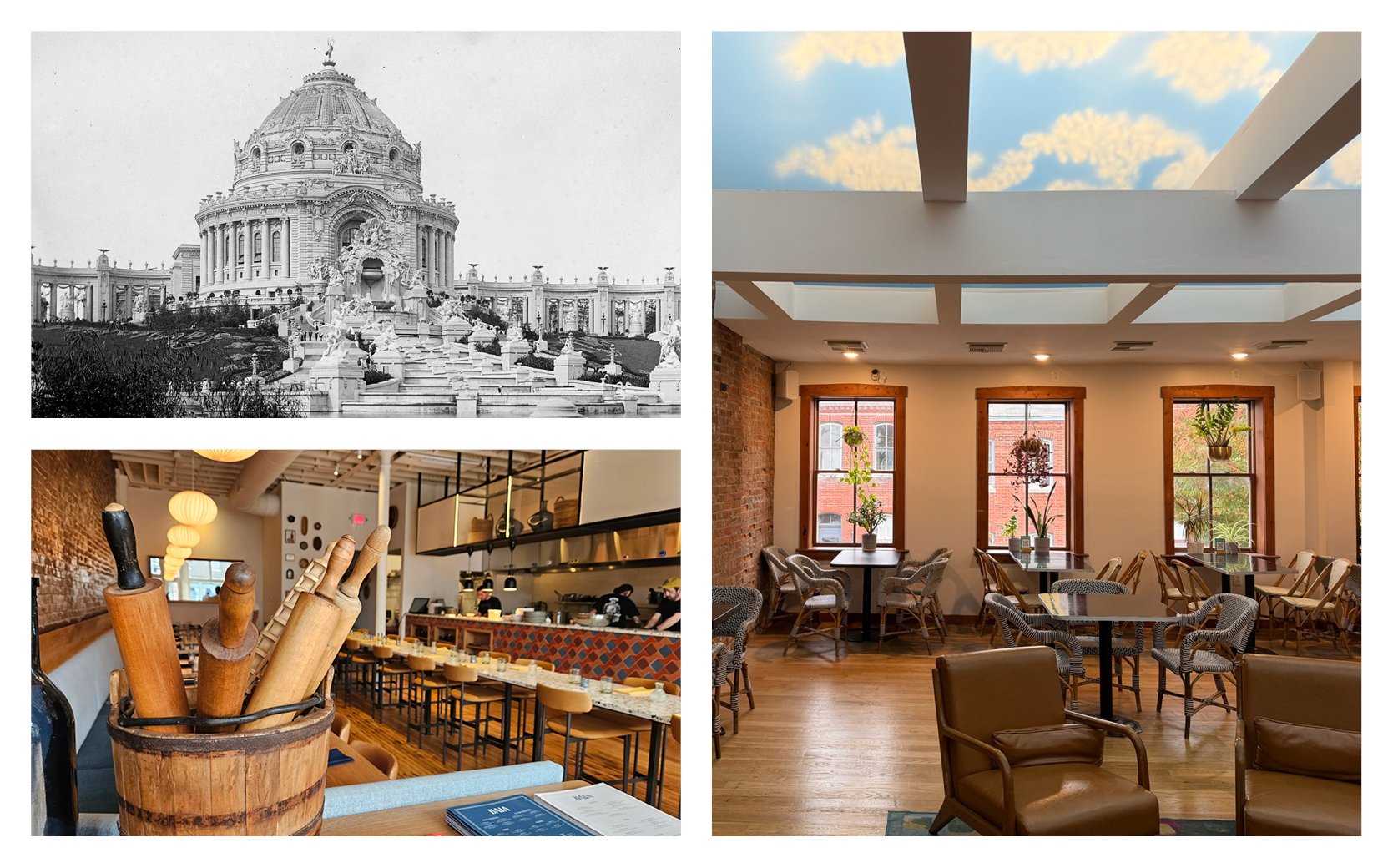
St. Louis Art Museum (upper left), Baia (lower left), Goshen Coffee Roasters (right)
Goshen Coffee, Soulard
Every trip starts with coffee, and Goshen Coffee in the heart of historic Soulard was the perfect first stop. The café fills a spacious two-level building with an outdoor garden patio, but the real surprise waits upstairs: a second-floor hangout space beneath a vaulted ceiling with clouds hand-painted overhead. It's a playful, unexpected moment that rewards guests for exploring and turns a quick coffee run into a reason to stay awhile.
St. Louis Art Museum
The Saint Louis Art Museum sits at the top of Art Hill in Forest Park, in the Palace of Fine Arts that Cass Gilbert designed for the 1904 World's Fair. While most of the fair's grand buildings were temporary, Gilbert's was built to be permanent, and it remains the sole surviving building from the fair.
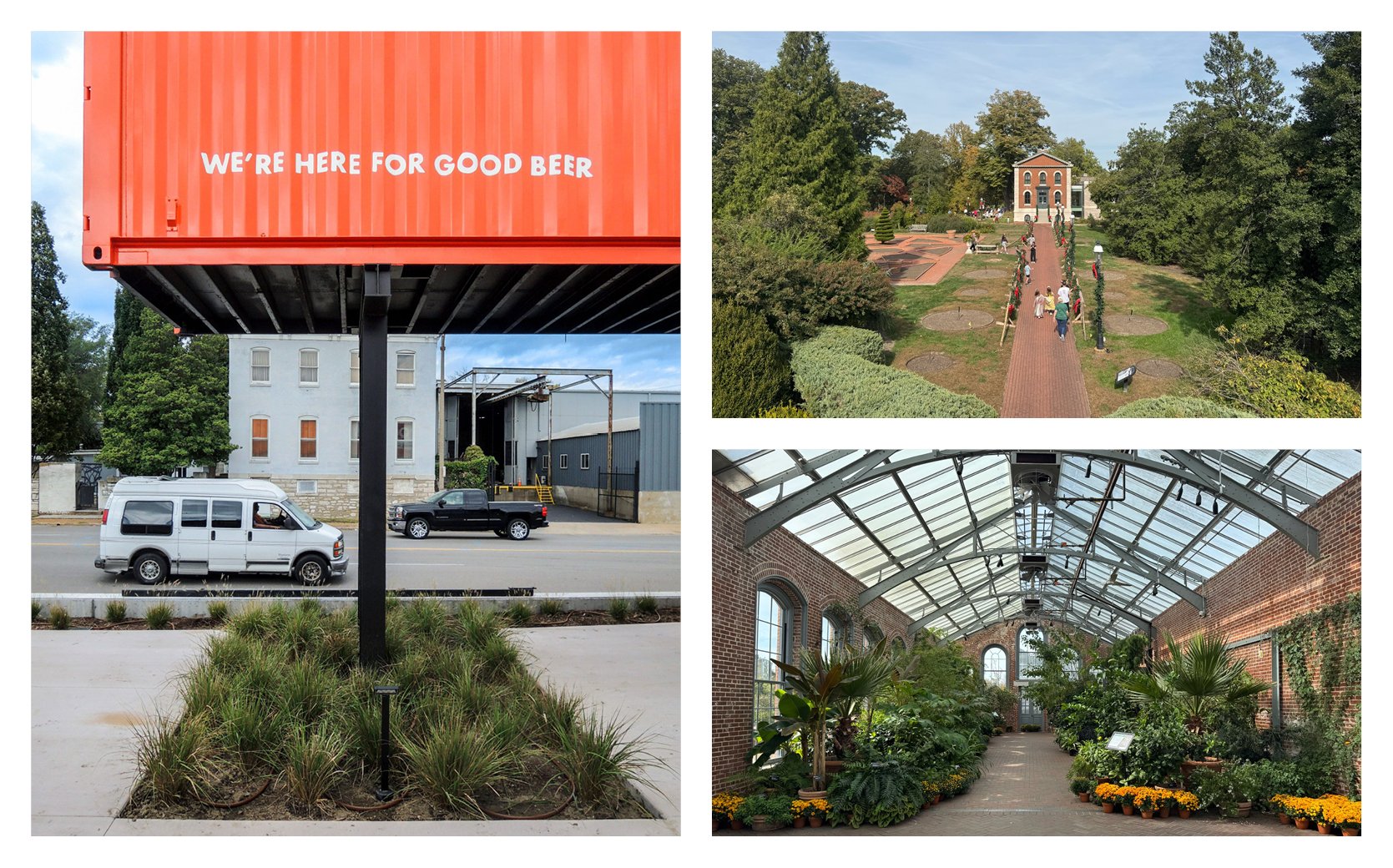
Rockwell Beer Company (left), Botanic Garden (right top and bottom)
In 2013, the museum opened its East Building by Sir David Chipperfield, a project that is especially meaningful to us since we collaborated with his studio on Akris. The addition is a quiet, confident counterpart to Gilbert's classical design: dark polished concrete walls speckled with Missouri River aggregate, a deep coffered concrete ceiling that filters daylight into the galleries and floor-to-ceiling windows framing views of the park. Old and new sit side by side without competing, and the addition increased the museum's gallery space by 30 percent.
Missouri Botanical Garden
Founded by Henry Shaw in 1959, the Missouri Botanical Garden was inspired to build a private estate with a public garden after touring historic gardens in Europe. All of the buildings tell the story of St. Louis’ growth and development, but the Climatron was the highlight of our visit. When it opened in 1960, it was the first geodesic dome ever used as a conservatory, built on the principles of Buckminster Fuller. The dome spans 175 feet and rises 70 feet at its center with no interior columns, so the entire structure is given over to light and plant life. Inside, more than 2,800 plants recreate a tropical rainforest, complete with waterfalls, rocky cliffs and a bridge through the canopy. The Climatron won the 1961 Reynolds Award for architectural excellence in aluminum and in 1976 was named one of the 100 most significant architectural achievements in United States history. More than 60 years later, it still feels futuristic.
Neon Greens
While in The Grove, we stopped at Neon Greens, a fast-casual salad shop with one of the most inventive business models I've seen. The restaurant grows its own greens on site in a hydroponic shipping container farm that uses vertical farming techniques and consumes 99 percent less water than traditional methods. A conveyor belt whimsically delivers the harvest straight to the kitchen inside the historic building. The design pairs adaptive reuse of a former coffee house with new construction: a gabled metal and glass structure that nods to a traditional farm greenhouse, with plexiglass paneling inside that carries the theme into the dining room. A light and airy seating area welcomes guests who want to linger while efficient grab-and-go serves patrons on the run.
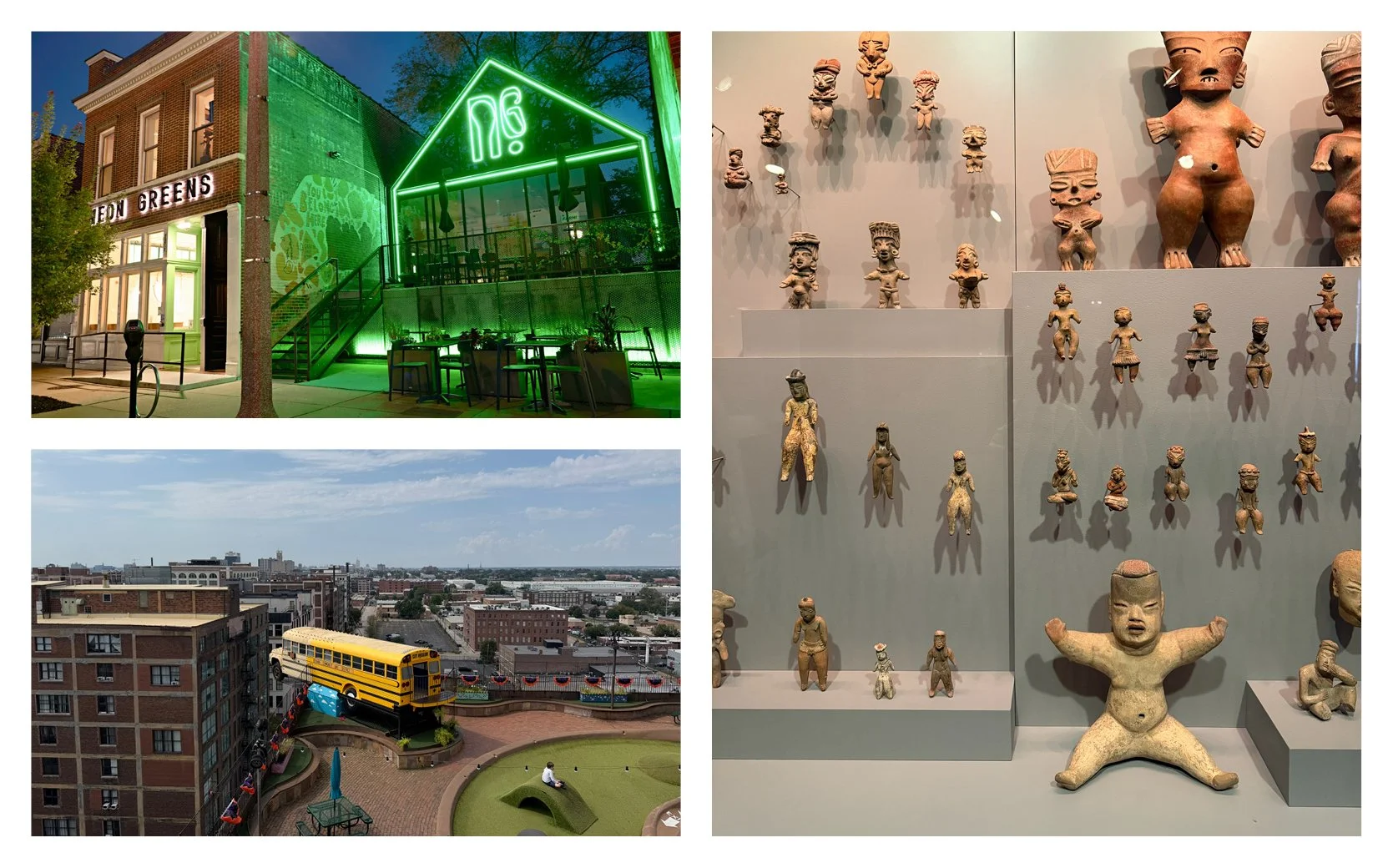
Neon Greens (upper left), City Museum (lower left), St. Louis Art Museum (right)
Rockwell Beer Company
Nearby, Rockwell Beer Company transforms a former industrial building into a 15-barrel brewhouse and tasting room. The project celebrates the interplay of the organic and industrial sides of brewing: brightly colored reclaimed shipping containers rise from a native prairie grass landscape, and a relocated crane frames the entry while supporting a cantilevered lightbox container overhead. Inside, reclaimed white oak from the scraps of the brewery's own foeder barrels forms the ceiling, guiding guests to the bar, kitchen and outdoor beer garden. Every material tells part of the brewing story, and the result is one of the best patios in St. Louis.
Baia
We loved Baia, an Italian respite in The Grove. Named for the Italian word for "bay" or "cove," the restaurant evokes the Italian Riviera with a palette of sandy beaches and driftwood, punctuated by splashes of bright blue, green, yellow, red and white. A bright blue storefront welcomes guests inside, where custom wood panels line a long handcrafted banquette. That homegrown, handcrafted quality makes the restaurant feel personal, as if it has been part of the neighborhood for years.
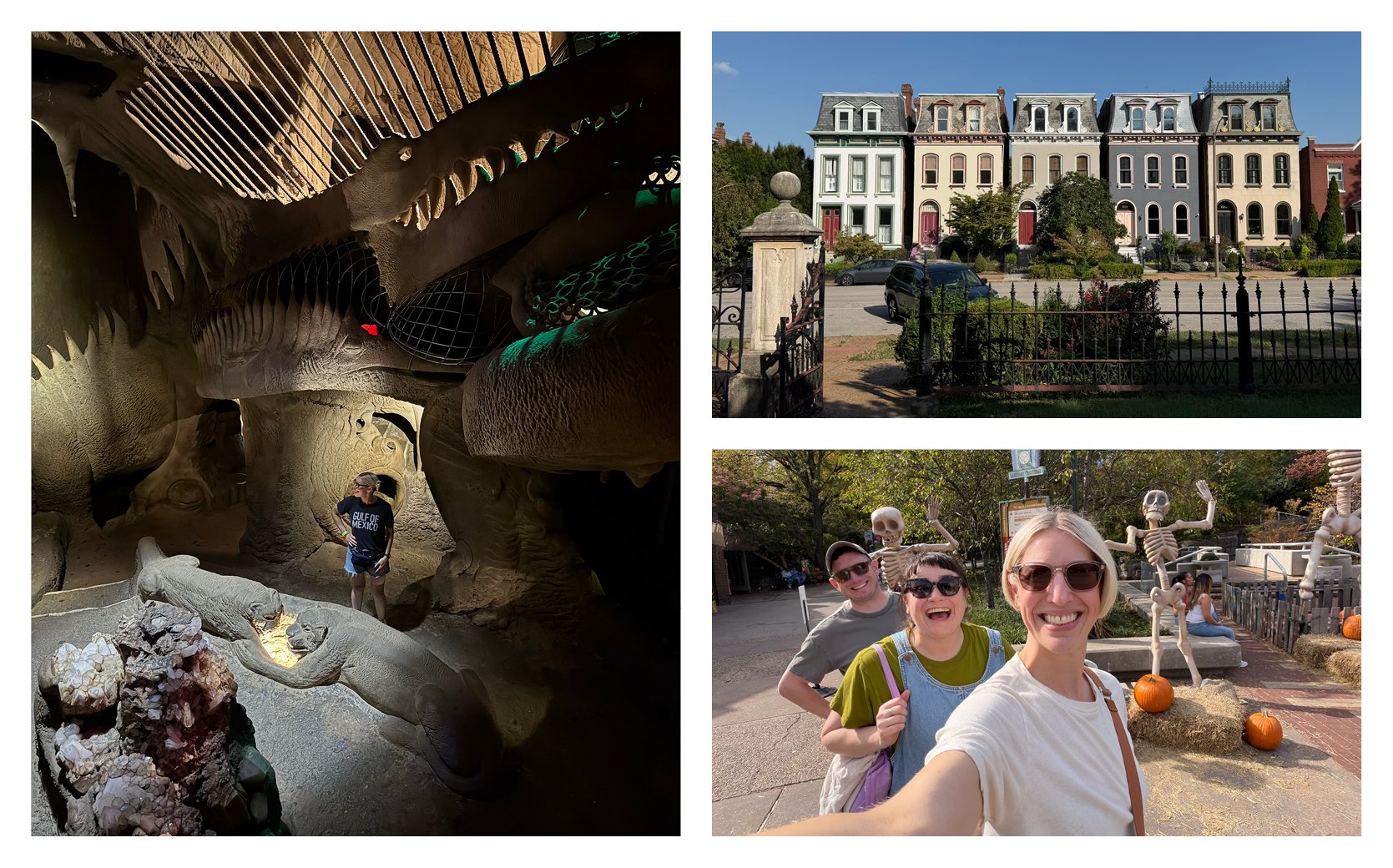
City Museum (left), Lafayette Square (upper right), St. Louis Zoo (bottom right)
City Museum
No trip to St. Louis is complete until you take your life in your own hands and explore the City Museum. Artists Bob and Gail Cassilly transformed the former International Shoe Company factory and warehouse into a playground built largely from repurposed architectural and industrial objects. Visitors climb through hand-sculpted caves, crawl up a giant Slinky made from an old refrigerating coil and ride ten-story slides inspired by the building's original spiral shoe chutes. On the roof, a school bus hangs over the edge, while outside, MonstroCity suspends two aircraft fuselages high in the air. It's adaptive reuse at its most joyful and a reminder that the most memorable spaces invite people to play.
Final Thoughts
The 1904 World's Fair brought a wave of optimism to St. Louis, and more than a century later, that spirit hasn't faded. The city still builds with ambition, experiments with purpose and doesn't take itself too seriously. For a designer, there's no better combination.
Lauren Chipman is the Chief Executive Officer of Chipman Design Architecture, where she provides creative leadership for one of the nation’s most established commercial architecture and design firms. A true multi‑disciplinary designer and former performing artist, Lauren brings an unconventional and forward‑thinking perspective to architecture, branding, and the built environment.
Before joining Chipman Design Architecture, Lauren built a successful career as a professional stringed instrumentalist, recording for television, film, and top Billboard artists. That background deeply informs her approach to design leadership today. Her ability to blend creativity with structure allows her to guide complex hospitality, retail, and restaurant projects with both vision and precision.
As a third‑generation leader of a family‑owned firm, Lauren is proud to carry on Chipman Design Architecture’s legacy while continuously pushing it forward. Under her leadership, the firm supports national and global brands including Chick‑fil‑A, Jeni’s Splendid Ice Creams, Ulta Beauty, and Whole Foods Market. Lauren’s entrepreneurial mindset extends beyond traditional architectural practice, emphasizing innovation, adaptability, and long‑term relevance.
Lauren actively integrates emerging technology into the conceptual design process and champions the recruitment of multi‑hyphenate talent with diverse professional backgrounds. By leveraging her experience as an industry outsider, she fosters a culture that values curiosity, inclusivity, and cross‑disciplinary collaboration. The result is a design practice that is both deeply experienced and future‑focused.
